
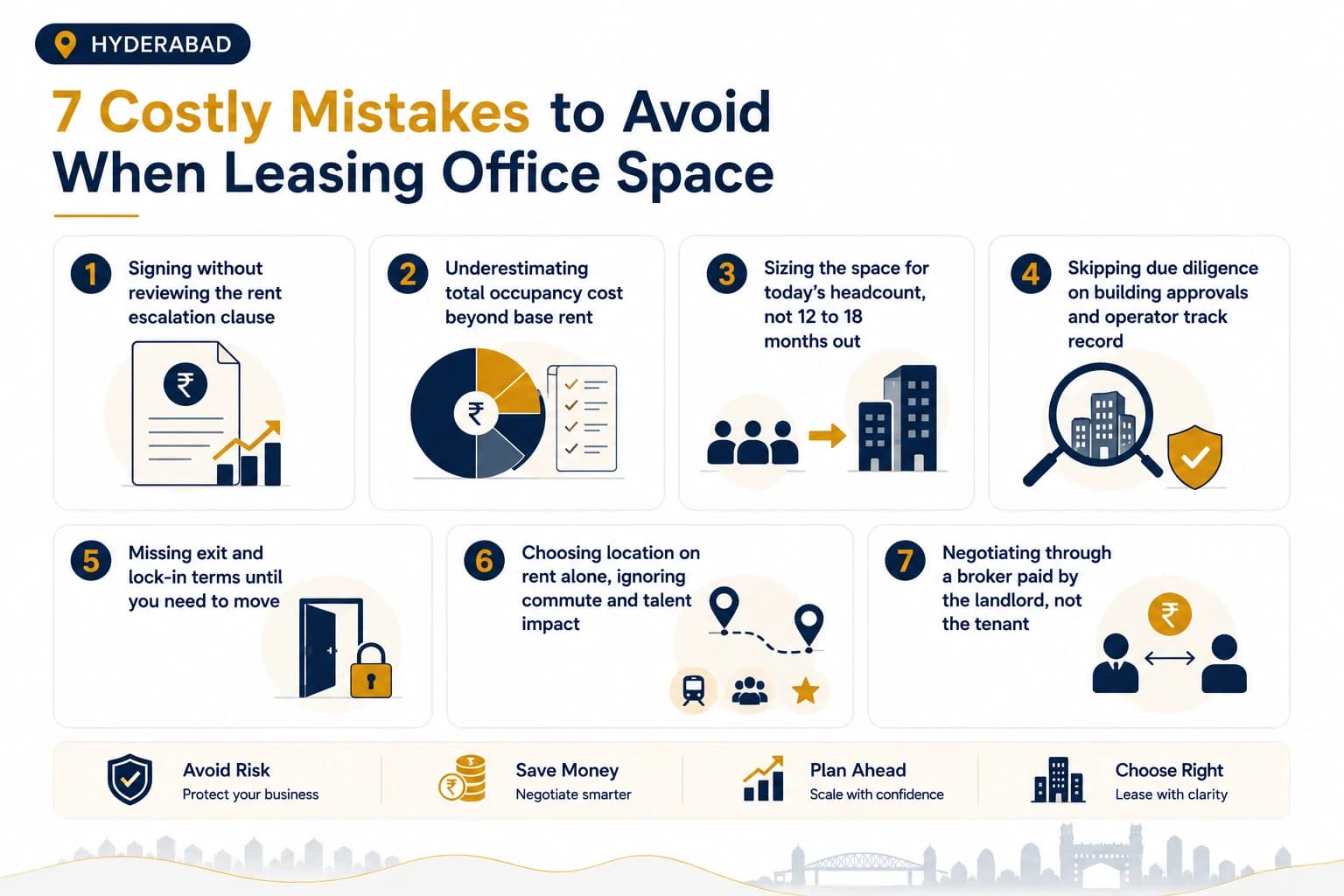
The 7 Mistakes Covered in This Guide
Why an Office Lease Is a Bigger Commitment Than Most First-Time Decision-Makers Realise
The average software subscription a Hyderabad company signs gets reviewed twice before approval: once by the budget owner, once by the person who will use it. The average office lease, a multi-year, multi-crore commitment that will determine where your team spends their working lives, gets reviewed once, often under time pressure, often by someone who has never negotiated a commercial lease before.
Indian office leasing crossed 18.3 million sqft in Q1 2026 alone, a 15 percent year-on-year increase. Most of those signings went smoothly. But a meaningful subset did not, and the ones that did not almost always trace back to the same seven mistakes, each one preventable with the right information before the agreement is signed rather than after.
This guide is written for the HR head, founder, or admin manager who has been asked to find office space and wants to know what to watch for. The examples are realistic composites drawn from PrimeDesk advisory experience, not invented scenarios. The lease terms, escalation percentages, and cost figures are all sourced from current Indian commercial leasing practice as of July 2026.
Mistake 1: Not Reading the Rent Escalation Clause
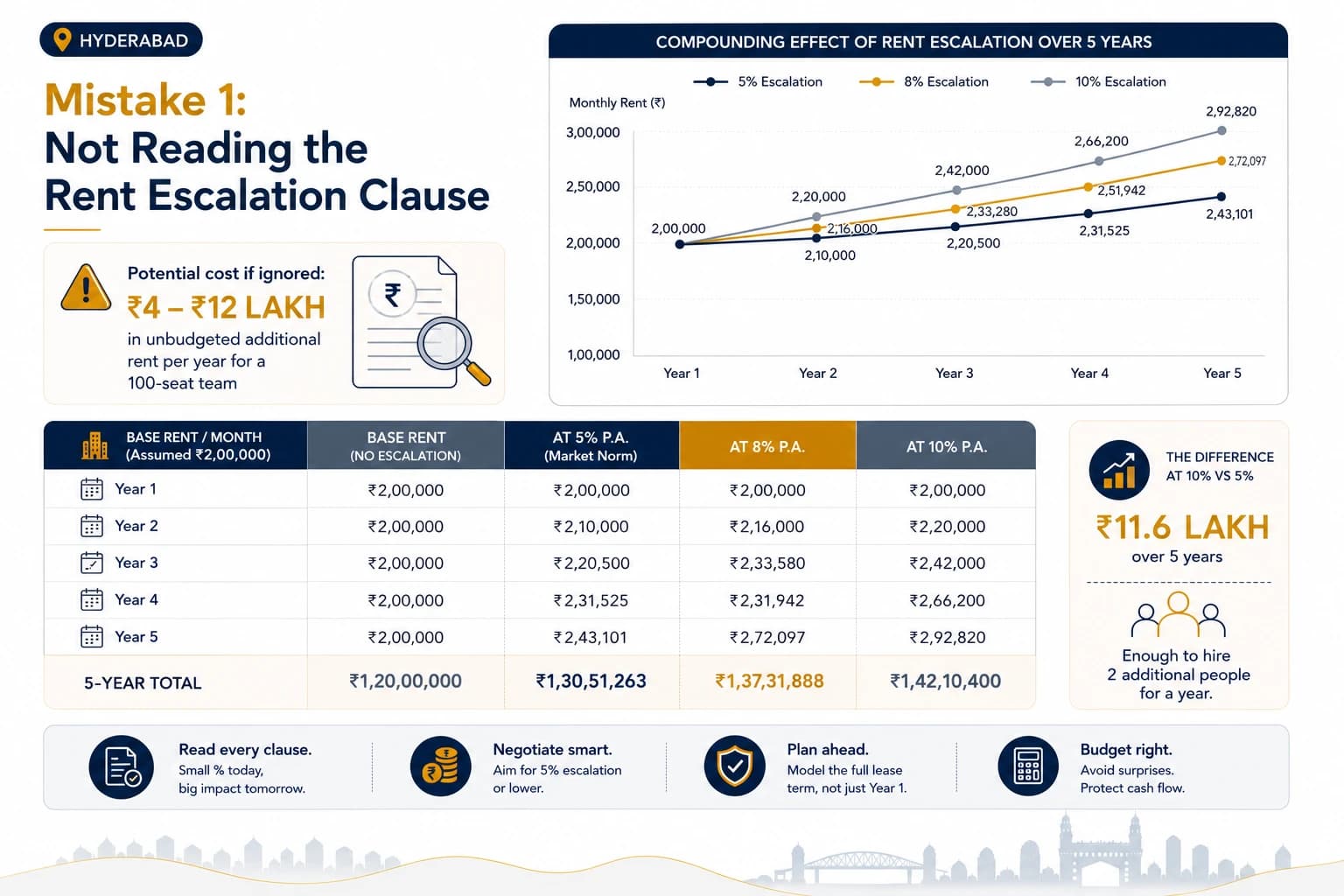
Every multi-year office lease in India includes a rent escalation clause. It is standard, legal, and expected. The problem is not that escalation clauses exist. The problem is that most first-time signers either do not read them carefully or accept the first number quoted without understanding the compounding effect over the full lease term.
The market norm in Hyderabad commercial leasing is 5 percent per year, confirmed by real transactions including HSBC's 2026 Hyderabad lease, which specifies a 5 percent annual escalation. Some landlords push for 8 to 10 percent, often framed casually as a “standard clause.” It does not sound dramatic. Here is what it means in practice:
| Year | Base rent/month | At 5% p.a. | At 8% p.a. | At 10% p.a. |
|---|---|---|---|---|
| Year 1 | Rs.2,00,000 | Rs.2,00,000 | Rs.2,00,000 | Rs.2,00,000 |
| Year 2 | Rs.2,00,000 | Rs.2,10,000 | Rs.2,16,000 | Rs.2,20,000 |
| Year 3 | Rs.2,00,000 | Rs.2,20,500 | Rs.2,33,280 | Rs.2,42,000 |
| Year 4 | Rs.2,00,000 | Rs.2,31,525 | Rs.2,51,942 | Rs.2,66,200 |
| Year 5 | Rs.2,00,000 | Rs.2,43,101 | Rs.2,72,097 | Rs.2,92,820 |
| 5-yr total | Rs.1,20,00,000 | Rs.1,30,51,263 | Rs.1,37,31,888 | Rs.1,42,10,400 |
At 5 percent, the five-year total cost is Rs.1.30 crore on a Rs.2 lakh per month base. At 10 percent, it is Rs.1.42 crore. The difference is Rs.11.6 lakh, enough to hire two additional people for a year, and it comes entirely from one unchecked clause.
Market norm is 5 percent per year. Anything above that deserves pushback. Ask for a CPI-linked escalation instead of a fixed percentage if CPI is consistently running below 5 percent. Get the escalation cap written into the agreement, not as a verbal assurance from the leasing executive.
Mistake 2: Underestimating Total Occupancy Cost
The headline per-seat price in any managed office quote is the number you will see in the first email from an operator or a broker. It is rarely the number you will actually pay per month.
Here is what all-in total occupancy cost typically looks like for a 100-seat managed office in Hyderabad, compared to what the base quote shows:
| Cost Component | Included in Base Quote? | Typical Monthly Amount (100 seats) | Annual Total |
|---|---|---|---|
| Base rent (Rs.8,000/seat) | Yes | Rs.8,00,000 | Rs.96,00,000 |
| GST at 18% | Rarely stated | Rs.1,44,00,000 | Rs.17,28,000 |
| Parking (20 cars at Rs.4,000/car) | Rarely included | Rs.80,000 | Rs.9,60,000 |
| CAM / maintenance charges | Sometimes separate | Rs.40,000 to Rs.1,00,000 | Rs.4,80,000 to Rs.12,00,000 |
| Meeting room overages | Not included | Rs.20,000 to Rs.60,000 | Rs.2,40,000 to Rs.7,20,000 |
| Security deposit upfront | Separate (3 to 6 months rent) | Rs.24L to Rs.48L one-time | Non-recurring |
| TOTAL effective monthly | -- | Rs.10,84,000 to Rs.11,84,000 | Rs.1.30Cr to Rs.1.42Cr/year |
The base quote of Rs.8,00,000 per month becomes Rs.10.8 lakh to Rs.11.8 lakh when all charges are added. On a 3-year lease, the underestimation compounds to Rs.1 crore or more in unbudgeted spend. Parking alone, at Rs.4,000 per car per month for 20 cars, adds Rs.9.6 lakh per year that many first-time signers never see coming.
Ask every operator to provide a total occupancy cost breakdown in writing before signing: base rent, GST, parking allocation and additional slot cost, CAM charges, meeting room inclusion policy, security deposit amount, and annual escalation. Compare apples to apples across operators before making a decision.
For a full cost breakdown by location: managed office space in Hyderabad
Mistake 3: Sizing for Today's Headcount, Not the Next 12 to 18 Months
This mistake is so common that PrimeDesk advisors see it in roughly one in three first enquiries. A 60-person team is looking for a 60-seat office. The logic seems sound. Why pay for empty desks?
Here is what happens six months later. The team closes a new funding round and hires 20 people. Now 80 people are in a 60-seat office. The options are: squeeze uncomfortably, exit the lease early and pay 2 to 3 months of break fees (Rs.16 lakh to Rs.24 lakh on a lease at Rs.8 lakh per month), or open a second location that splits the team and doubles your facility management overhead.
None of these outcomes was inevitable. The right answer at the time of signing was to plan for 12 to 18 months of projected headcount, not current headcount, and negotiate an expansion provision into the original agreement. An expansion provision allows you to add seats mid-lease, or activate an adjacent floor, without triggering a new agreement or paying break fees.
The headroom formula: Target seats = current headcount + projected 12-month net hires + 10 to 15 percent buffer. A 60-person team expecting to hire 20 in the next year should be signing for 88 to 92 seats, not 60.
Read the full seat planning guide: figure out how much space you actually need
Mistake 4: Skipping Due Diligence on the Building and Operator
A managed office agreement is only as reliable as the operator behind it. Most buyers evaluate the building (correctly) and the fit-out (correctly) but spend very little time verifying whether the operator is financially stable, legally registered, and operationally capable of managing the space for the duration of the lease.
The specific things to verify before signing any managed office agreement:
Several managed office operators in India expanded aggressively between 2021 and 2023 and are now under financial pressure. An operator who is losing money on their own lease with the building owner has an incentive to compromise on facility standards, delay maintenance, or in extreme cases, terminate your agreement early. This is not speculation. It has happened to Hyderabad tenants. PrimeDesk vets operator financial standing before including any building in our network.
Mistake 5: Not Reading the Exit and Lock-In Clauses Until You Need to Leave
The exit clause is the part of a managed office agreement that most tenants read last and wish they had read first. It defines three things that matter enormously when business conditions change:
The reinstatement clause deserves specific attention. Some operators require you to restore the space to its original pre-fit-out condition on exit. For a 100-seat managed floor with custom branding, IT infrastructure, and partition work, reinstatement can cost Rs.5 lakh to Rs.15 lakh. Ask for this clause to be waived or capped at a fixed amount before signing.
Get the notice period, lock-in duration, break fee amount, and reinstatement requirements all written explicitly into the agreement before signing. Verbal assurances from the leasing team do not survive a change in ownership or management at the operator.
PrimeDesk · Zero Brokerage
Want a lease reviewed before you sign?
PrimeDesk advisors have reviewed hundreds of managed office agreements in Hyderabad. We flag risk clauses before they become expensive. Zero brokerage.
Mistake 6: Choosing Location Based on Rent Alone
This mistake shows up on spreadsheets as a saving. It only becomes visible later in hiring conversion rates and attrition numbers.
Rent is the most comparable number between two shortlisted locations. It is also the least complete basis for a location decision. The commute experience of your team affects hiring conversion, day-to-day attendance, and employee satisfaction in ways that a Rs.1,000 per seat difference in rent does not compensate for.
Here is a concrete example. A 100-seat IT team chose a location 8 km outside the Hitech City corridor because the per-seat rent was Rs.2,000 lower. Over 12 months, they found that senior engineer candidates consistently declined offers, citing the commute as the deciding factor. They could not fill 12 roles at a fully-loaded cost of Rs.3 to Rs.5 lakh per role in lost productivity per month. The Rs.24 lakh per year they saved on rent was offset several times over in hiring friction.
The location factors that actually matter, beyond rent:
See location comparison: managed office space in Hitech City | Gachibowli | Financial District
Mistake 7: Using a Broker Paid by the Landlord to Negotiate on Your Behalf
This is the mistake that makes all the other six harder to avoid.
Most office leasing brokers in Hyderabad are paid by the landlord or the managed office operator. Their commission is a percentage of the total lease value, paid once the agreement is signed. This creates a structural incentive: the broker benefits from the largest possible lease, with the fewest delays, signed as quickly as possible. They do not benefit from flagging the escalation clause, negotiating the break fee down, or asking the landlord to waive reinstatement costs.
This is not a criticism of individual brokers. It is a description of how the standard Indian commercial brokerage model is structured. The broker who most enthusiastically helps you find a building is often the broker least able to protect you when reviewing what you are signing.
The alternative is a zero-brokerage advisory model where the advisor is working on behalf of the tenant, not the landlord. The advisor is incentivised to find the best fit for your requirement, negotiate the most favourable terms, and flag risks before signing, because their relationship with you is more valuable to them than any single transaction.
PrimeDesk charges zero brokerage to the tenant. Our fee is covered by the operator once a lease is signed. We are incentivised to get you the right building at the right terms, not the most expensive building signed fastest. We negotiate across multiple operators simultaneously, which creates competitive pressure that a single direct conversation with one operator does not produce.
See how zero brokerage works: see how zero brokerage works
How a Zero-Brokerage Advisory Model Removes Points 2, 4, 5, and 7 from This List
Four of the seven mistakes on this list are, in practice, advisory failures rather than knowledge gaps. Most HR heads and founders know they should read the escalation clause, verify the building approvals, and understand the exit terms. What they lack is the time, the market knowledge, and the counterpart experience to do it effectively under deal pressure.
Mistakes 1, 3, and 6 require your input: you have to share your escalation tolerance, your growth plan, and your team's commute zones. We handle the rest.
PrimeDesk · Zero Brokerage
About to sign an office lease in Hyderabad?
PrimeDesk reviews your requirement, shortlists verified buildings, and negotiates terms on your behalf. Zero brokerage. Response within 24 hours.
Frequently Asked Questions
Sources and Methodology
Lease term data sourced from: HSBC Hyderabad lease (Business Standard, July 2026), Indian commercial leasing practice standards (Cityinfo Services, JuriGram, NoBrokerage, 2026), and PrimeDesk advisory experience across 200+ Hyderabad managed office transactions. Cost figures are illustrative composites based on current Hyderabad market data and are not attributable to any specific client. All figures are subject to individual negotiation and market conditions at time of signing.